It is the third week of the month and the rooms department manager is staring at a P&L line she did not create: “Allocated Expense – General Areas,” $4,200, sitting quietly under her department’s costs. She did not order the lobby furniture. She does not manage the front porte cochere landscaping. Yet somehow, a share of it landed on her statement, and it dragged her departmental profit down for the second month in a row.
Ask five hotel controllers who should absorb the cost of the lobby, and you will likely get five different answers. That is not because USALI is vague. It is because departmental P&L allocation is one of the most misunderstood parts of hotel accounting, and getting it wrong quietly distorts everything from GM bonus calculations to owner trust.
What USALI Actually Separates
The Uniform System of Accounts for the Lodging Industry organizes a hotel’s financials into two distinct buckets before anything ever gets allocated:
Operated departments generate revenue directly. Rooms, food and beverage, spa, and golf are the classic examples. Each one carries its own revenue, its own direct labor, and its own direct expenses, and each produces a departmental profit line.
Undistributed operating expenses support the whole property but do not sell anything themselves. Administrative and general, sales and marketing, property operations and maintenance, information and telecommunications systems, and utilities all fall here. These costs exist because the hotel operates, not because any single department asked for them.
Gross Operating Profit is what remains after both categories are subtracted from total revenue. On paper, the structure is clean. In practice, the lobby is where it gets complicated.
The Lobby Problem: Shared Space, Shared Confusion
The lobby is not its own department under USALI. It has no line item, no revenue center, and no dedicated P&L. But it is not free to operate either. Someone pays for the marble floor cleaning, the lobby bar staff during slow afternoons, the seasonal decor, and the front desk agents who greet guests before they ever check into a room.
Most properties default to parking lobby-related costs inside the rooms department, since rooms revenue is typically the largest and the lobby is, functionally, an extension of the check-in experience. That works reasonably well when the lobby is purely transactional. It works far less well when the lobby doubles as an F&B outlet, an event pre-function space, or a co-working lounge that multiple departments benefit from.
When that happens, hotels start making judgment calls, and judgment calls made inconsistently month to month are exactly what erode the credibility of a departmental P&L.
Common Allocation Methods and Where They Break Down
There is no single USALI-mandated formula for splitting shared-space costs across departments, which is precisely why so many properties handle it differently. The most common approaches include:
- Square footage allocation, where shared costs are split based on the physical space each department occupies or uses. Straightforward for cleaning and utilities, less accurate for costs like staffing that do not scale with square feet.
- Revenue-based allocation, where costs follow the proportion of revenue each department generates. Simple to calculate, but it can unfairly burden a strong-performing department simply because it is doing well.
- Usage-based allocation, tracking actual utilization, such as event hours booked in a pre-function lobby space. More accurate, but harder to maintain without a system that captures usage data continuously.
- Headcount or labor-hour allocation, useful for shared staff, but it requires accurate time tracking across departments, something many properties still manage on paper or in disconnected timekeeping tools.
None of these methods is wrong. The problem is switching between them, applying them inconsistently across properties in a portfolio, or reworking the allocation manually every month in a spreadsheet that only one person understands.
Why Getting This Right Actually Matters
Departmental P&L allocation is not an academic accounting exercise. It has real consequences:
GM and department head compensation. Many management contracts and incentive plans tie bonuses to departmental profit. An inconsistent or inaccurate allocation can unfairly reward one department head and penalize another for the exact same shared cost.
Owner reporting and trust. Owners and asset managers compare departmental profit margins month over month and against industry benchmarks. If the allocation methodology shifts without explanation, owners notice, and it raises questions about the reliability of the entire financial package.
Portfolio benchmarking. Multi-property operators need departmental profit to mean the same thing at every hotel in the portfolio. If one property allocates lobby costs by square footage and another allocates by revenue, comparing GOP margins across properties becomes an apples-to-oranges exercise.
Budgeting and forecasting. Next year’s budget usually starts with this year’s actuals. If this year’s allocation was inconsistent, the budget inherits that distortion before the year even begins.
Why Manual Allocation Falls Apart at Scale
For a single property, an allocation spreadsheet is annoying but manageable. For a portfolio of ten, thirty, or a hundred properties, it becomes a liability. Someone has to remember which method each property uses, rebuild the allocation formulas every month, and reconcile the results before the owner report goes out. When that person is out sick or leaves the company, the methodology often leaves with them.
This is also where errors compound. A square-footage allocation built on outdated blueprints, or a revenue-based split that was never updated after a renovation added new event space, can quietly misstate departmental profit for years without anyone noticing until an owner or auditor asks a pointed question.
How Real-Time Departmental Reporting Fixes This
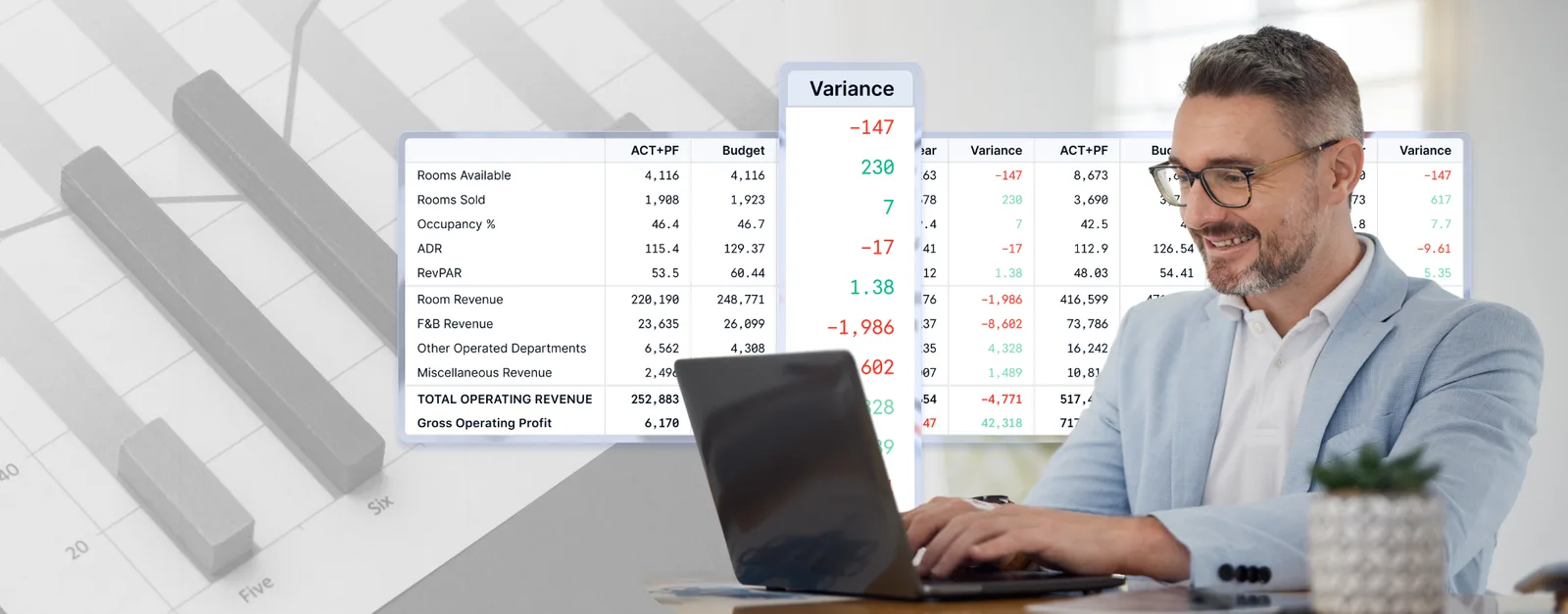
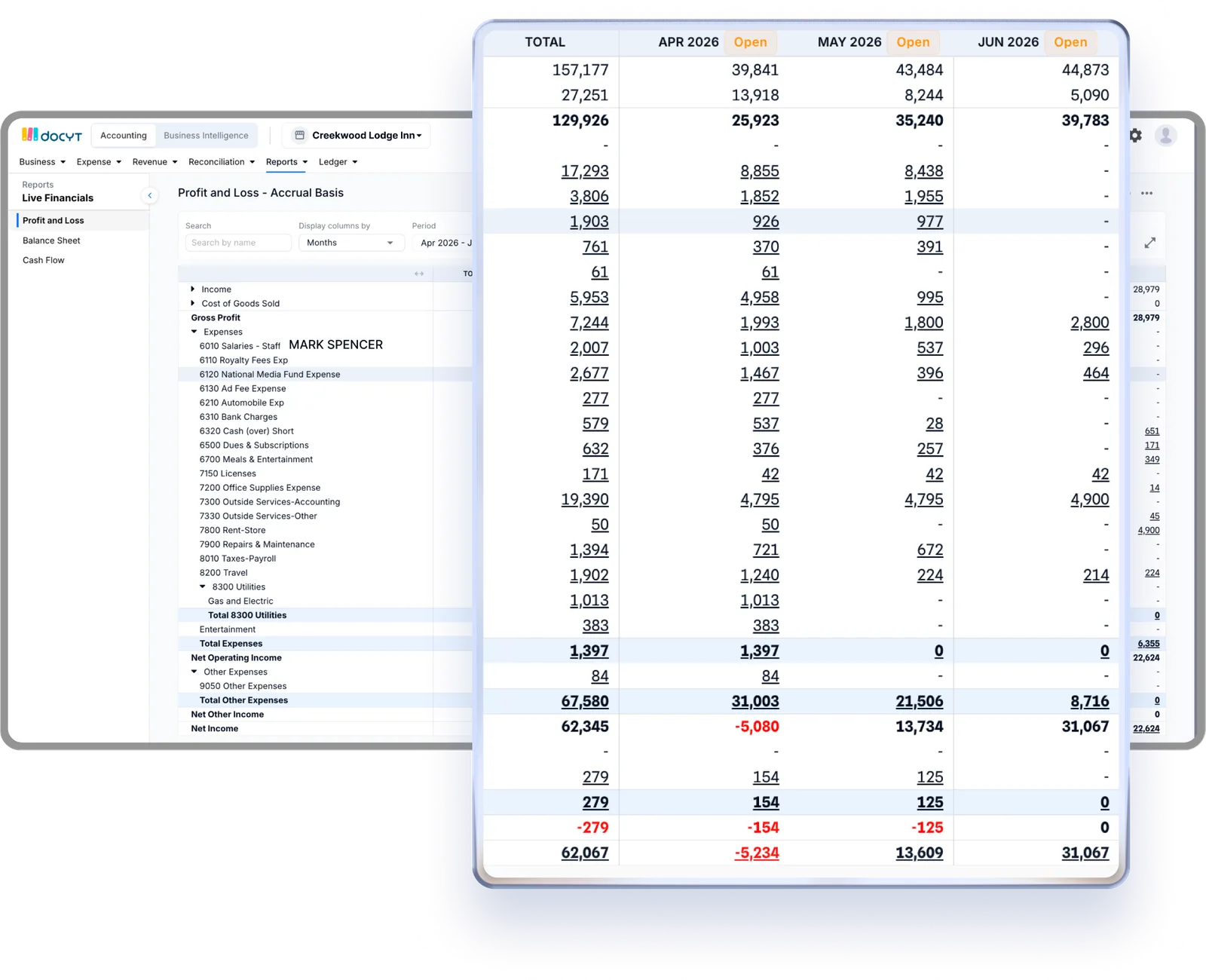
At Docyt, we built real-time, USALI 11th edition-compliant reporting specifically because we kept hearing this exact problem from hospitality finance teams: the departmental P&L structure is correct, but the process of getting there is manual, inconsistent, and stuck at month-end.
We apply consistent allocation logic across every property in a portfolio, so a departmental profit figure at one hotel means the same thing at every other hotel in the group. Because we reconcile revenue and expenses continuously throughout the month rather than in a single month-end push, departmental P&Ls stay current, and shared costs like lobby and common area expenses are allocated the same way every time, not re-derived from scratch by whoever happens to be closing the books that month.
That consistency matters just as much for month-end close as it does for departmental reporting itself. When the allocation methodology is built into the platform rather than rebuilt in a spreadsheet, close moves faster because there is one less manual reconciliation step standing between the finance team and a finished report.
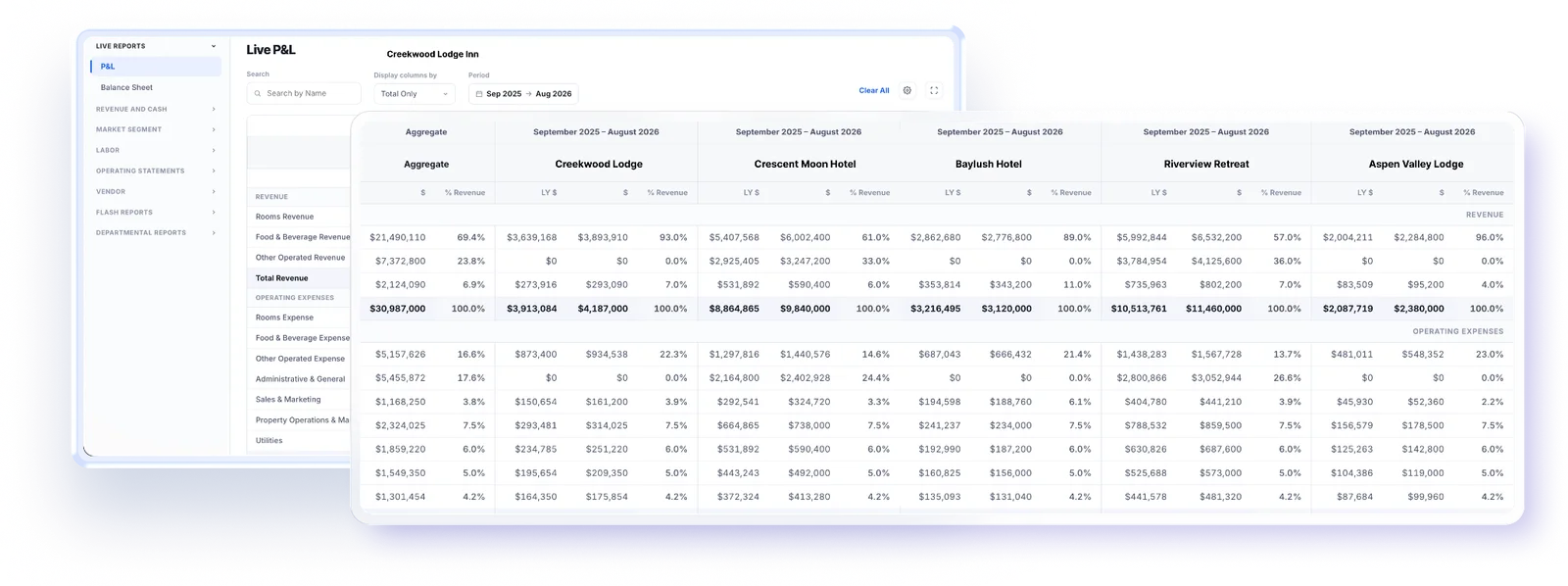
Multi-property operators in particular benefit from this consistency. Our hospitality accounting platform gives owners and management companies a single, standardized view of departmental performance across every property, so a GOP comparison between two hotels is actually comparing the same thing.
The Broader Industry ContextUSALI has required standardized departmental reporting for decades, and the American Hotel & Lodging Association’s Financial Management Committee has continued to refine those requirements, including expanded labor cost detail introduced in the 11th revised edition (hotel-online.com). That level of standardization is exactly why lenders, owners, and management companies rely on USALI-based statements to make apples-to-apples comparisons across properties (costar.com). But standardization on paper only holds up if the methodology behind it is applied the same way every month. The framework tells a hotel what buckets exist. It does not automate the discipline required to fill them consistently, and that discipline is where most properties still struggle.
Summary Overview:
- USALI separates hotel financials into operated departments (rooms, F&B, spa) and undistributed operating expenses (A&G, sales and marketing, property operations, utilities).
- The lobby and other shared common areas are not their own department, which creates inconsistent allocation practices across properties.
- Common allocation methods include square footage, revenue percentage, usage-based tracking, and labor hours, each with tradeoffs.
- Inconsistent allocation distorts GM incentive compensation, owner reporting, portfolio benchmarking, and next year’s budget.
- Manual, spreadsheet-based allocation does not scale across a growing portfolio and is prone to silent, long-running errors.
- Real-time, standardized departmental P&L reporting applies the same allocation logic across every property, so departmental profit means the same thing everywhere in the portfolio.
If your departmental P&Ls tell a different story depending on which property, which month, or which spreadsheet you are looking at, it may be time for a system that applies the same standard every time.
Schedule time with a Docyt expert to see how real-time, USALI-compliant departmental reporting works across your portfolio.